
Mix & Post-Production
Preparing drum recordings for the final sound - from raw tracks to a finished mix.
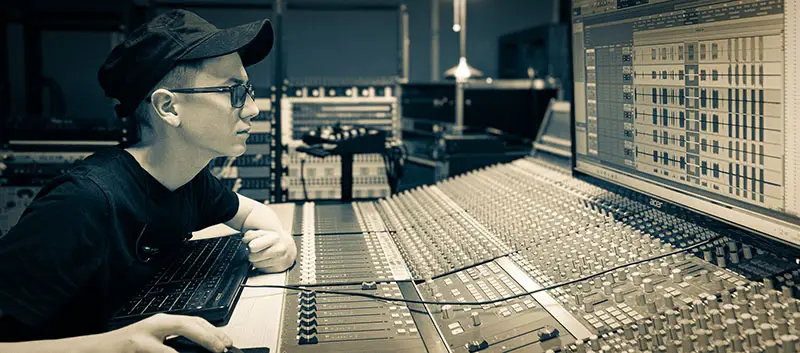
The work begins with organizing the material: track selection, edit control, and checking the relationships between microphones. Each element of the kit is treated individually, but decisions are made in the context of the full kit and the arrangement.
(More about the equipment used can be found in the GEAR section.)
Scope of work
Analysis of relationships between close mics, overheads, and ambient mics. Correction of time offsets (sample alignment), polarity control, mono compatibility checks. In practice: recovering low end of the kick, stabilizing the body of the snare, organizing the overall kit image.
Setting input and working levels to preserve dynamics and leave space for further processing. Eliminating clipping and uncontrolled peaks.
Manual editing of bleed, removing unwanted hits, controlling decays. When needed, selective use of gates, expanders, and clip gain editing - without destroying natural tails and ghost notes.
Corrections only where they affect the groove. Work based on transients, micro-timing shifts, and the grid - without "quantizing everything".
Subtractive and corrective EQ: removing boominess, resonances, and masking between kit elements. Creating space for kick and snare without conflict with bass and the rest of the mix.
Dynamic control on individual tracks and groups. Different attack and release times depending on function (transient vs sustain). Peak compression and RMS compression for stability.
Parallel "drive" of the kit or selected elements. Blending dry signal with heavily compressed signal to increase density, sustain, and perceived energy without losing attack.
Shaping attack and decay (transient shaping) instead of excessive compression. Control of kick "click" and snare articulation.
Adding or replacing samples (sample replacement / layering) to stabilize the sound or change its character. Phase and timing always matched to the original.
Building space using short rooms, ambiences, and longer reverbs. Setting predelay, decay time, and filtering (HPF/LPF on returns) to avoid smearing transients and muddying the mix. Reverb automation when needed.
Setting the kit image (drummer's or listener's perspective), controlling the width of overheads and ambient mics, ensuring mono compatibility.
Working on drum buses - shared compression, saturation, and overall glue. Controlling relationships between groups (kick, snare, toms, OH, room).
Adding harmonics to increase clarity and density - subtle or aggressive, depending on the material.
Adjusting levels, reverbs, and parameters over time - for example different settings in verses and choruses.
Replacing individual hits, rebuilding sections, and in extreme cases reconstructing entire tracks.
Extracting drums from a finished stereo track when multitracks are not available.
Each project is analyzed before work begins - I check recording quality, track count, technical issues, and the intended sonic direction. The scope of work and pricing are defined individually.